

By Red Shoes | Updated June 2026 | 6 min read

Who was your top friend on Myspace? If you remember, you also remember a time when social media was a novelty rather than a business necessity. We have come a long way from curated “About Me” pages and 140-character tweets. Today, social media is woven into how people discover, research and decide what to buy, and a business without a plan for it is leaving growth on the table.
As of early 2026, more than 5.6 billion people use social media worldwide, which is roughly two-thirds of the global population, according to DataReportal. The average user bounces between about seven different platforms a month. The opportunity is enormous, but so is the noise. The businesses that win are not the ones posting the most. They are the ones posting with a strategy.
What is a social media strategy?
A social media strategy is a documented plan that defines what you want to achieve on social media, who you are trying to reach, which platforms you will use, what you will post and how you will measure success. It connects your social activity to real business goals instead of treating posting as a box to check. Without one, content becomes reactive and inconsistent. With one, every post has a purpose.
Why your business needs a social media strategy in 2026
The case for being on social media is no longer about reach for its own sake. It is about being present where buying decisions begin.
Social platforms are now a primary discovery engine. Research from GWI shows social media ads rank as the third most important source of brand awareness, behind only search engines and TV, with more than 30 percent of adult internet users saying they find new brands and products through social. For younger audiences, social has also become a search engine in its own right: a growing share of Gen Z starts product and local-business research on TikTok, Instagram and YouTube rather than Google.
A strategy is what turns that visibility into results. It helps you:
- Show up consistently so your brand stays familiar and top of mind.
- Reach the right people instead of shouting into the void, by focusing effort on the platforms your customers actually use.
- Build trust through content that educates and connects rather than just sells.
- Measure what works so your budget and time go toward the tactics that drive leads, sales or recruitment.
Skipping the strategy is how businesses end up busy but not effective: lots of posts, little to show for them.
What has changed: the 2026 social landscape
If your last social media plan is more than a year or two old, the ground has shifted under it. A modern social media management approach has to account for several developments.
Short-form video dominates. Reels, TikToks and YouTube Shorts now account for the majority of time spent on social. Static posts still matter, but video is how most discovery happens, and each platform rewards native, platform-specific clips over recycled content.
Social commerce is mainstream. Shopping increasingly happens inside the app. TikTok Shop, Instagram Checkout and Pinterest shopping let users buy without ever leaving the platform, which shortens the path from discovery to purchase.
AI is now a content partner. Marketers use AI tools to draft captions, generate variations, schedule posts and analyze performance. Used well, AI speeds up production. Used lazily, it produces generic content audiences scroll right past.
Platform roles keep shifting. X has lost trust and traffic among many users and journalists, while Facebook remains the largest platform overall and LinkedIn has become a trusted home for thought leadership. Picking platforms by habit instead of by current data is a common and costly mistake.
How to build a social media strategy step by step
You do not need to be on every platform or chase every trend. You need a clear sequence. Here is the framework we use with clients.
1. Define your audience
Your social audience should mirror the target audience in the rest of your marketing. If you have not mapped it yet, analyze your current customers, review your website analytics and research your competitors to understand who you are actually trying to reach. Get specific about age, location, interests and the problems your product solves. This single step prevents the most common error in social media: choosing platforms based on assumptions instead of evidence.
2. Set goals and the KPIs that prove them
Decide what social media is supposed to do for the business. Common goals include building brand awareness, establishing authority, generating leads, driving website conversions or supporting recruitment. Each goal needs key performance indicators (KPIs) you can track month over month, such as reach, engagement rate, click-throughs, leads or applications. Goals also dictate platform choice and content, so they come before any posting begins.
3. Choose the right platforms
Match platforms to your audience and goals rather than spreading yourself thin. A focused presence on two platforms beats a neglected presence on six. This quick reference can help:
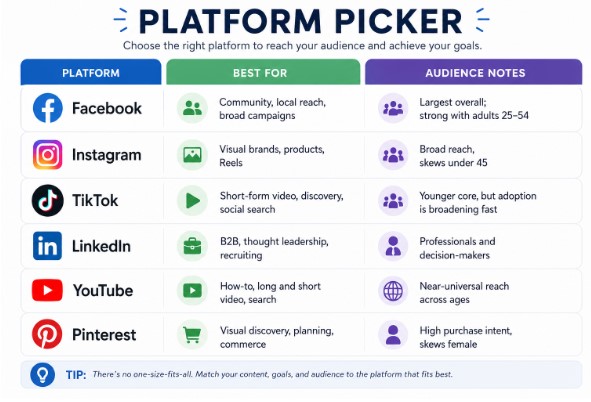
4. Build a content mix
Every post from your business should be deliberate and tied to a goal, but that does not mean every post should sell. Audiences want to be informed and entertained, and on social media you are competing for attention against your customers’ friends and family, not just your competitors. A balanced mix keeps people engaged and builds trust.
For example, if your goal is supporting a recruitment campaign, your calendar might look like this:
- 50 percent highlighting open roles and the hiring process
- 25 percent showcasing company culture
- 20 percent sharing relevant industry news
- 5 percent directly promoting your brand
Lead with native short-form video where you can, and adapt the format to each platform rather than cross-posting the same asset everywhere.
5. Engage, do not just broadcast
Social media was built to be social. Posting and disappearing wastes the channel. People expect timely responses to comments and messages, and engaging with them is as important as the content itself. Replying, asking questions and joining relevant conversations signals that there are real people behind your brand, which is exactly what builds loyalty.
6. Analyze and adjust
Set a regular cadence to review your KPIs. Most platforms include built-in analytics, and dedicated tools can give you deeper insight into what is resonating. Look for the content types, formats and posting times that perform, double down on them, and do not be afraid to pivot when something is not working. Strategy is a loop, not a one-time document.
Common mistakes to avoid
The fastest way to undercut a good plan is to post inconsistently, treat every channel the same, chase trends that do not fit your audience, or ignore the analytics telling you what to do more of. A little discipline beats a lot of guesswork.

Frequently asked questions
Does my small business really need a social media strategy?
Yes. A strategy matters more for smaller businesses, not less, because your time and budget are limited and a plan ensures both go toward tactics that actually drive results. You do not need to be everywhere, just intentional about the few platforms where your customers spend time.
How many social media platforms should my business be on?
Quality beats quantity. For most businesses, two to three platforms chosen to match your audience and goals will outperform a thin presence across six. Start focused, prove results, then expand only when you can maintain quality.
How often should a business post on social media?
Consistency matters more than volume. A steady, sustainable cadence you can keep up beats a burst of daily posts followed by weeks of silence. Set a realistic schedule tied to your capacity and adjust based on what your analytics show is working.
How do I measure social media success?
Tie every goal to specific KPIs and review them monthly. Awareness goals map to reach and impressions, engagement goals to likes, comments and shares, and conversion goals to click-throughs, leads and sales. The right metric depends entirely on what you set out to achieve.
What is the difference between a social media strategy and a content calendar?
The strategy is the why and who: your goals, audience, platforms and measurement. The content calendar is the what and when: the specific posts scheduled to execute that strategy. You need the strategy first, or the calendar is just guesswork.
Put your strategy to work
Social media offers an incredible opportunity to connect with your audience, but only when it is backed by a clear plan. Define your audience, set goals, choose your platforms with intention, build a balanced content mix, engage genuinely and measure as you go. Do that, and social becomes a real growth channel rather than a time sink.
If you would rather hand it to a team that does this every day, Red Shoes can help you build and run a strategy that fits your brand and your goals, and connect it to your broader marketing plan, paid social advertising and influencer partnerships. Get in touch and let’s make the most of your channels.
Back to Blog